Description
K-Type slot sensing at a fixed detection gap
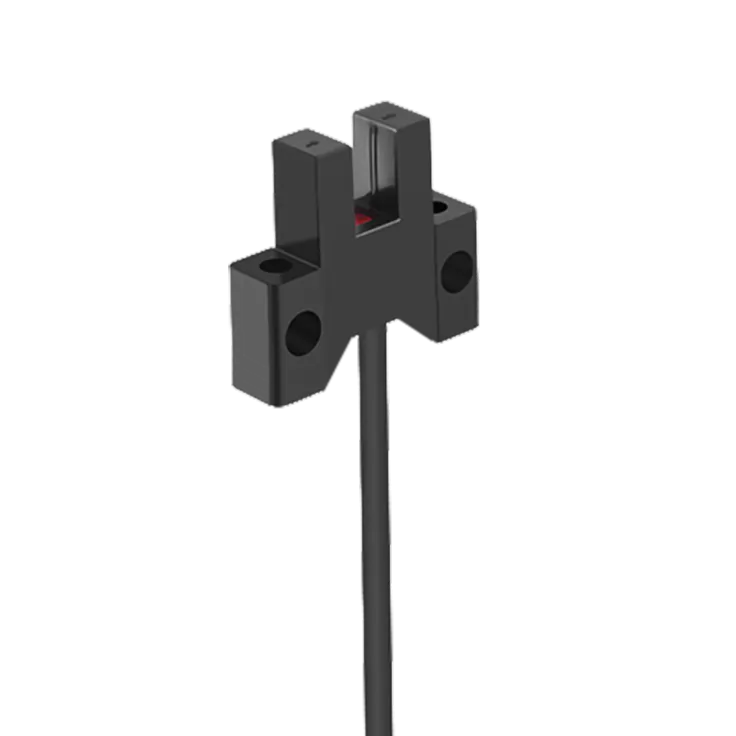
The XSZ K-Type Slot Photo Sensor belongs to the company’s slot photoelectric sensor range. In a slot sensor, the emitter and receiver face across a fixed opening; a suitable target passing through the opening interrupts the light path to produce a detection signal.
The K-Type housing should be selected around the target path and mounting position. Confirm the exact opening, beam location, electrical output and connection for the model being ordered.
Match the target to the optical gap
The moving part must pass through the slot without contacting the housing and must interrupt enough of the beam for a repeatable signal. Evaluate the smallest target as well as its largest sideways movement at the actual detection point.
Opaque flags, tabs or guided part edges are starting points for sample testing. Translucent or clear materials may transmit light through the sensing path and should not be assumed detectable without a product-specific test.
Selection checks before specifying the K-Type model
Check the actual product specification against the machine before ordering. Slot-sensor dimensions and output behavior vary by model; the housing style alone does not establish electrical compatibility or detection speed.
- Opening width and depth, beam position, target thickness and clearance through the full travel path.
- Minimum detectable target under stated conditions and repeatable switching with the intended material.
- Supply voltage, output type, switching logic, load limit and approved wiring for the exact code.
- Response time, target speed and spacing, controller input timing and the installation environment.
Installation and sample testing
Guide the target through the specified beam position and leave clearance for vibration, runout and alignment tolerance. Secure the sensor bracket, route the cable without strain and keep the optical windows accessible for inspection.
During a sample trial, check beam-clear and beam-blocked states at the slowest and fastest operating conditions, then confirm that the controller captures each intended signal. Use the selected model’s wiring diagram rather than assuming the same conductor assignment as another slot sensor.
Frequently asked questions
How does a slot photo sensor detect a passing object?
An emitter and receiver face each other across the slot. A suitable target produces a signal change when it interrupts the optical path. The output logic depends on the selected model.
How should I choose the slot opening?
Allow enough clearance for the target’s thickness and path variation, then confirm the beam position and minimum detectable object separately. A wider opening does not by itself establish finer detection.
Can the K-Type detect transparent material?
Do not assume so. Clear or translucent material may not interrupt enough light. Test the actual sample or select a sensing method specified for that material.
What information is needed before connecting it to a controller?
Confirm the exact model’s supply, output, switching behavior and wiring diagram, then check the controller input and required signal timing.