
Part presence
An NPN sensor reports when a part enters a defined sensing zone.

Sensor Terminology
Meaning, Current Path & NPN Sensor Wiring
A sourcing DC input supplies current from the controller's positive supply path toward a field device. In a typical 24 VDC circuit, an NPN sensor turns that input ON by completing the path to 0 V. The label alone is not a wiring instruction: confirm the input group's actual circuit and common terminal.

In the ON state, current leaves the sourcing input and returns through a compatible sinking device.
A sourcing input is a DC controller input circuit that provides a path from the positive supply through its input-sensing element to the field wiring. A compatible field device must complete the path toward supply negative for input current to flow. In common 24 VDC examples, that device is an NPN transistor output or a suitably wired dry contact.
“Sourcing” here describes the input's current direction. It does not mean the connected sensor is PNP; an NPN sensor is the typical complementary output.
In a typical DC circuit, current can flow from the module's positive supply through the input-sensing circuit and out of the input terminal. When the NPN output is OFF, that external path is open and the input remains inactive. When the NPN output turns ON, it sinks the current toward 0 V and the controller can register an active input.
The NPN transistor is open, so the input has no intended return path through that output.

The NPN transistor conducts. Current flows from the input circuit through the sensor output to supply negative.

Illustrative current path: positive supply → controller input-sensing element → input terminal → ON NPN output → 0 V. The actual input circuit and ON/OFF thresholds are module-specific.
They describe opposite current-flow arrangements on the controller side. A sourcing input typically pairs with a sinking NPN output; a sinking input typically pairs with a sourcing PNP output. The controller's common wiring and circuit diagram decide the match.
| Question | Sourcing DC input | Sinking DC input |
|---|---|---|
| Input-side current direction | Supplies current outward to the field device | Receives current from the field device |
| Typical matching sensor output | NPN (sinking) | PNP (sourcing) |
| Example ON-state path | +V → input circuit → NPN output → 0 V | +V → PNP output → input circuit → 0 V |
| Typical input-group common | Connected to positive supply in a documented sourcing configuration | Connected to 0 V in a documented sinking configuration |
| What to verify | Exact module schematic, group common, input voltage/current limits, output leakage and sensor supply reference | |
Manufacturers sometimes label the same arrangement by the field device it accepts rather than by the input's own current direction. Trace the current path in the manual instead of selecting hardware by a label alone.
These examples show the electrical relationship, not a universal terminal layout. Use the exact PLC and device manuals for terminal numbers, polarity, supply range, input current and any shared common.
Power the sensor within its rating. Connect its NPN signal to the sourcing input; use the input group's documented positive-supply common and a shared 0 V return where required.
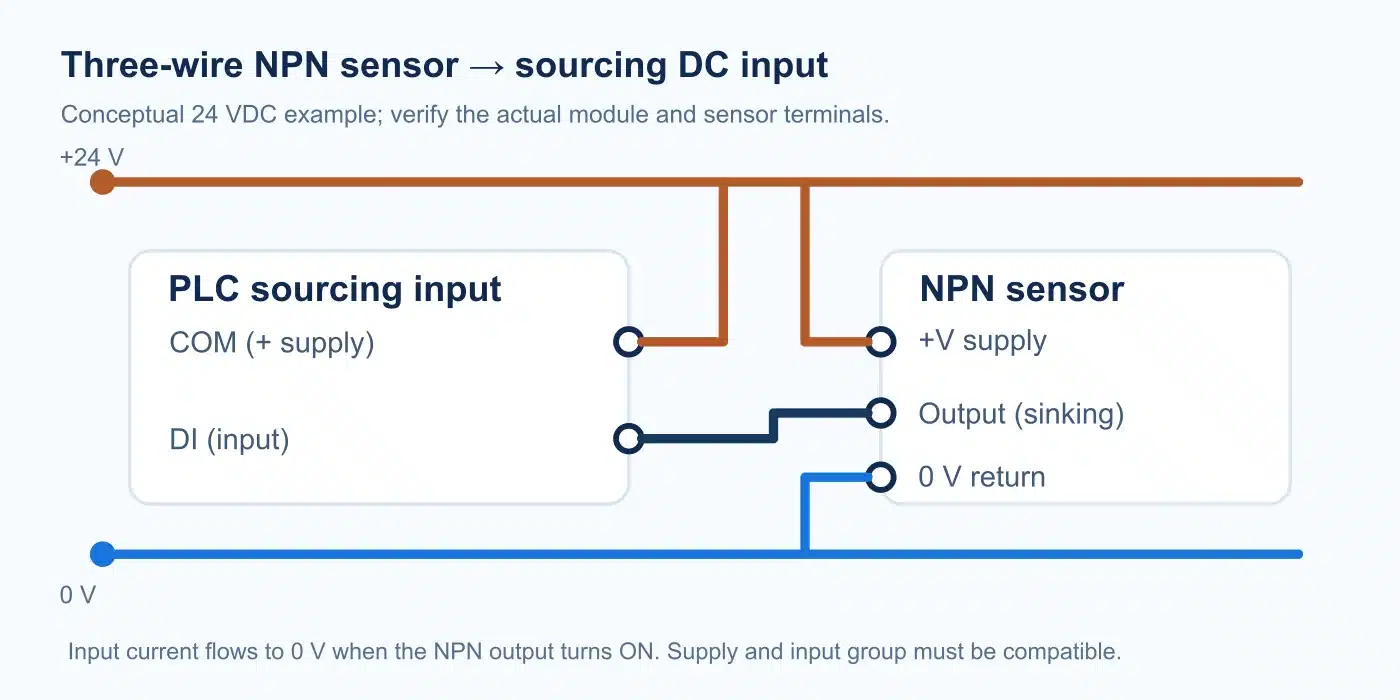
For a compatible DC input, a contact can complete the path from the input terminal to 0 V. A dry contact does not supply power by itself.

They are useful wherever the controller must read a compatible sinking output or contact closure. The sensing method and controller function still depend on the selected devices and application.
An NPN sensor reports when a part enters a defined sensing zone.

A compatible proximity sensor provides a discrete position signal.

A suitable NPN-output level sensor switches at a chosen level.

A compatible dry contact completes the input's DC current path.
Often yes: in the conventional DC arrangement, the input supplies current and the ON NPN output sinks it to 0 V. Confirm both devices' voltage/current specifications and the module's group common.
No. “Sourcing input” describes a controller input circuit. A PNP sensor is a sourcing output; it normally pairs with a sinking input, not a sourcing input.
No. 24 VDC is a common industrial example, not a definition. Use the exact module's rated supply and input thresholds.
It can when the input module's DC wiring instructions permit it and the contact completes the appropriate path to the supply return. Check the module schematic and contact rating.
Possible causes include a mismatched common, missing shared return, wrong sensor output mode, insufficient input current or a wiring fault. Isolate power before changing connections and compare the measured behavior with both manuals.
Share the sensor model, controller input-module number, supply voltage and input-group wiring diagram for a model-specific review.