
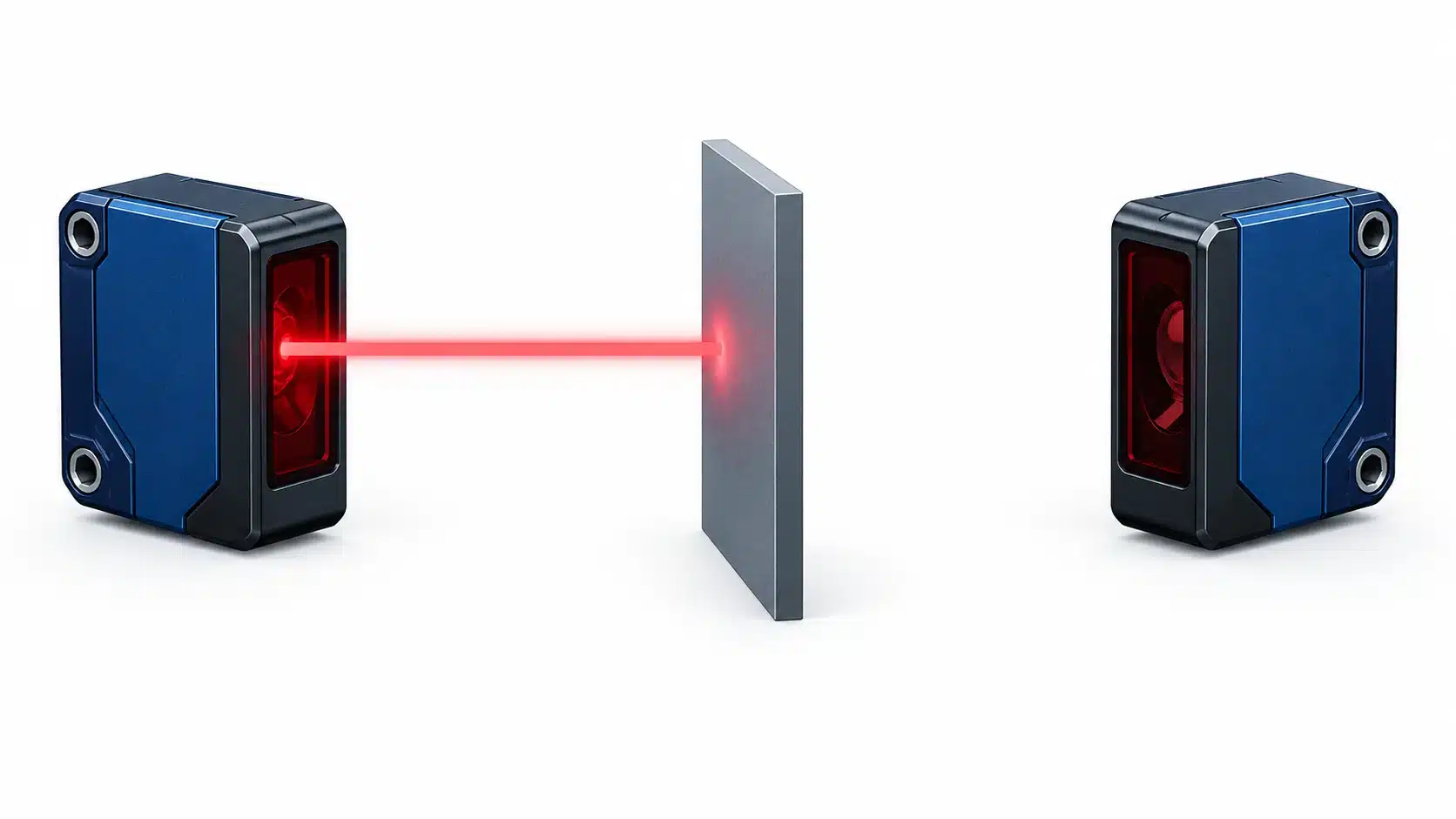
What Is a Photoelectric Sensor?
It is an optical sensor that changes an electrical output when the received light changes in a specified way. An emitter provides light; a receiver monitors the light path. The emitter and receiver may be separate devices or built into one housing. Unlike an inductive sensor, a photoelectric sensor is not limited to metal targets—but detecting a particular object still depends on its optical properties and the installation.
A change in light reaching the receiver is evaluated against the sensor’s switching condition.
The object can be detected without a mechanical contact or switch actuation.
The optical principle does not determine NPN/PNP or light-on/dark-on behavior; check the actual model.
How Does a Photoelectric Sensor Work?
The emitter sends a defined light beam toward a receiver, reflector or target. An object changes the amount of light received—by blocking the beam or reflecting light back. The electronics evaluate that change and switch the configured output when the detection threshold is met.
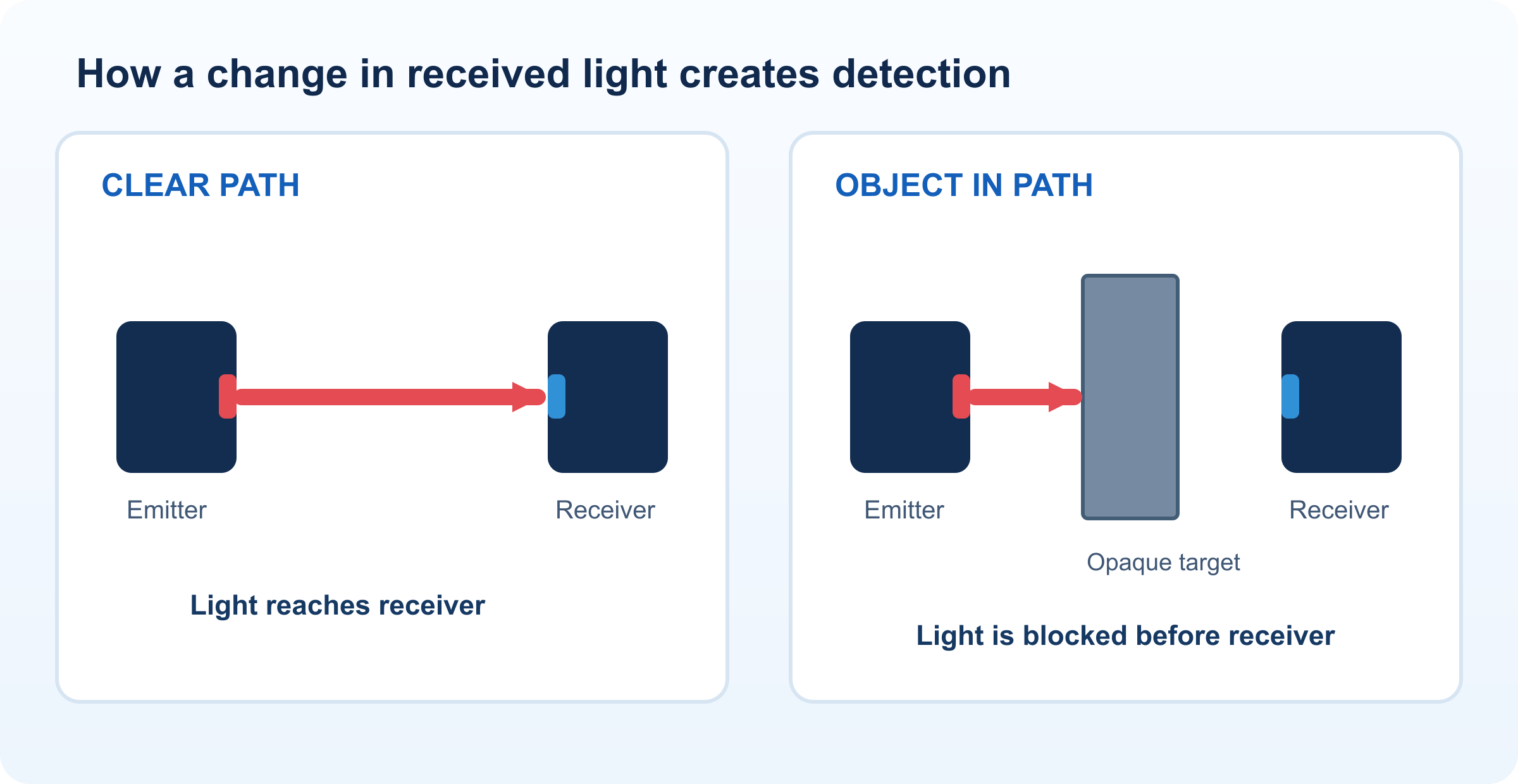
Which Photoelectric Detection Type Should You Use?
Start with the optical path you can physically install. These three arrangements answer different presence-detection needs; none has one guaranteed distance or target performance across all products.
Through-beam
A separate emitter and receiver face each other. The object is detected when it interrupts the beam. Choose this when you can mount devices on both sides of the target path.
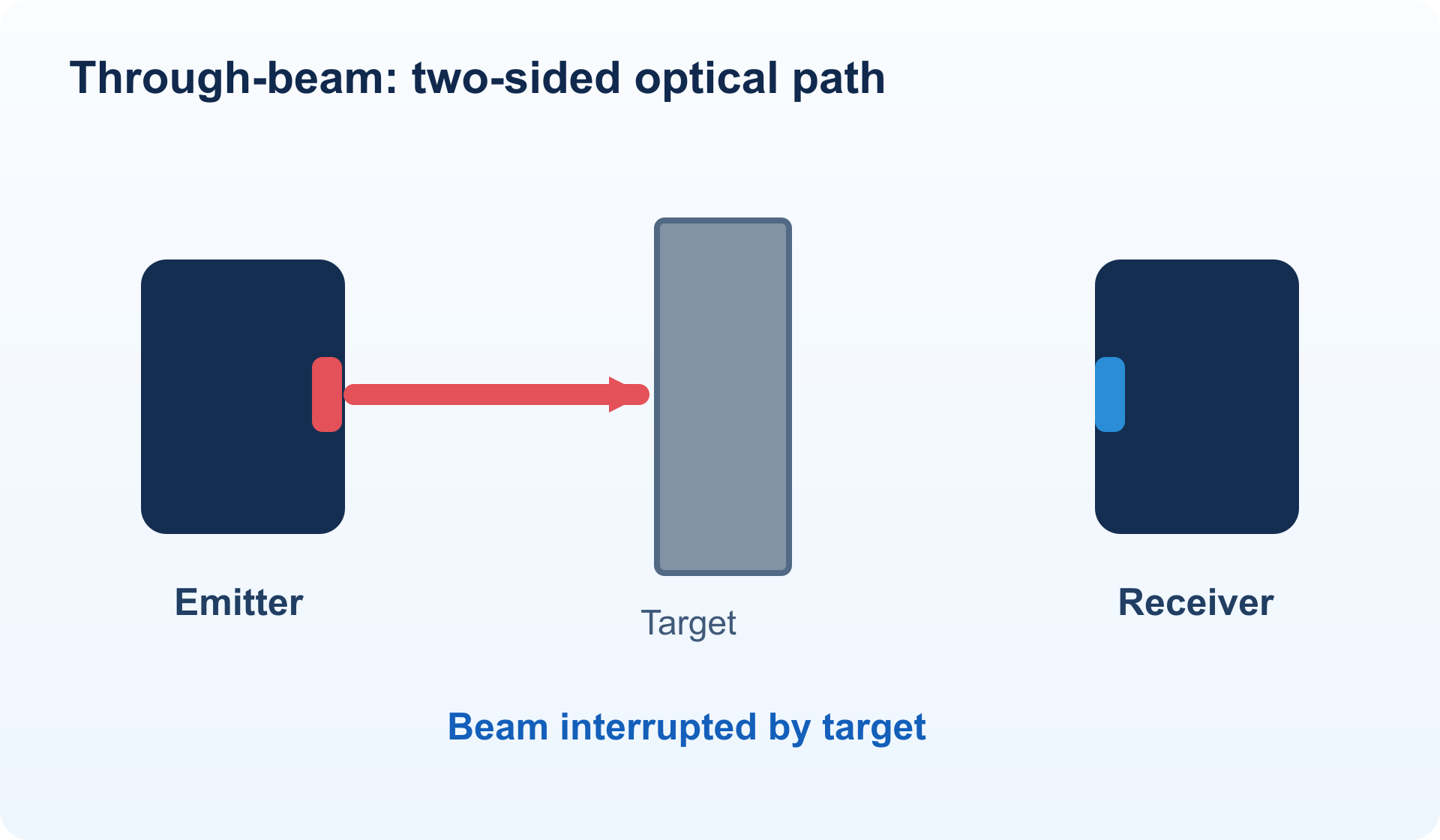
- Light path
- Emitter → object path → receiver
- Typical trigger
- Beam interruption
- Installation check
- Two-sided access, alignment and the smallest target
Retroreflective
Emitter and receiver share a housing; a separate reflector returns the light. The object is detected when it interrupts the return path. A shiny or transparent target may need a purpose-designed model.
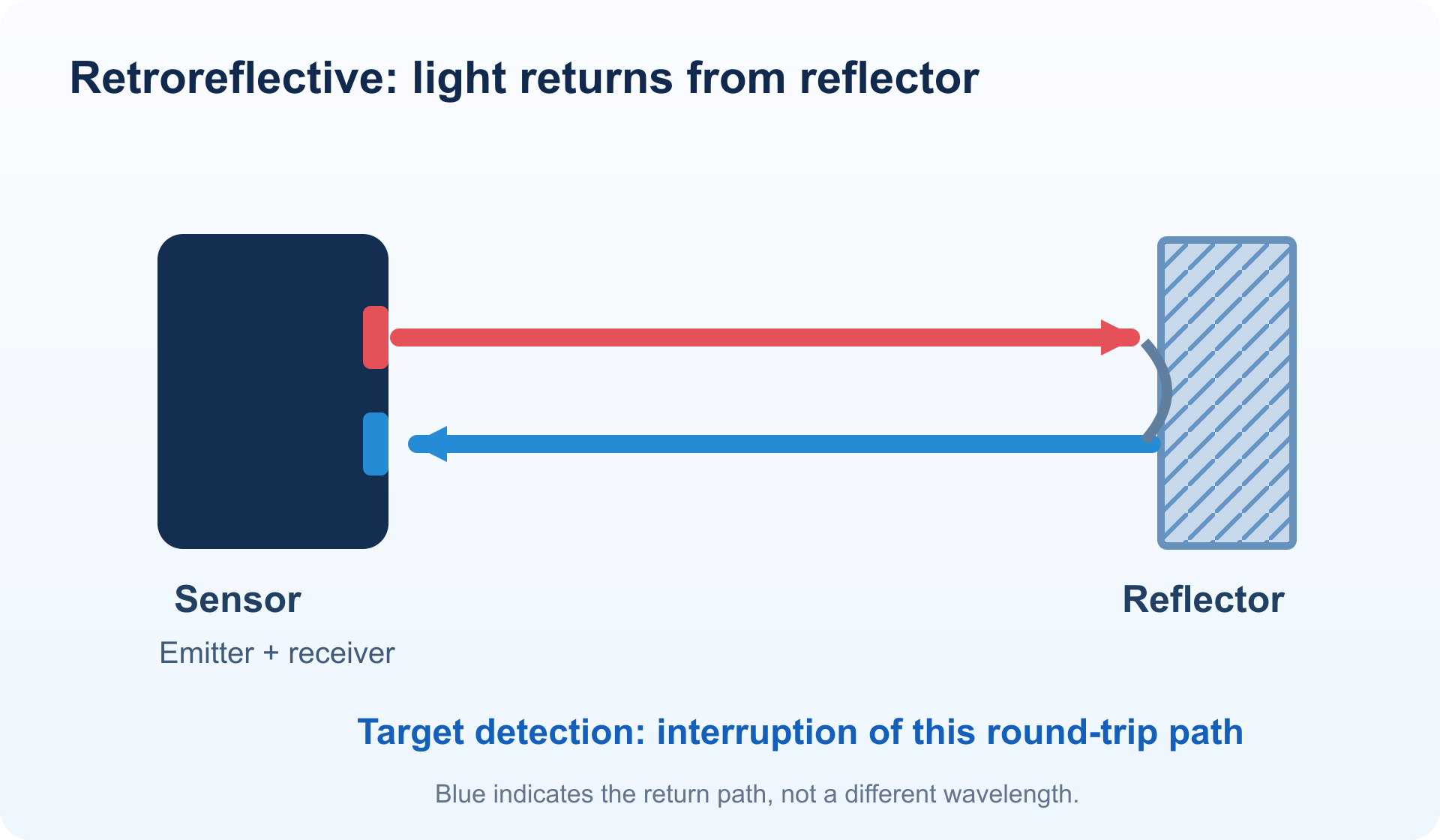
- Light path
- Sensor → reflector → sensor
- Typical trigger
- Reduced returned light
- Installation check
- Reflector position, target optics and bypass reflections
Diffuse reflective
Emitter and receiver share a housing, and the target itself returns light. This supports one-sided mounting, but target color, finish and background can change the usable detection distance.
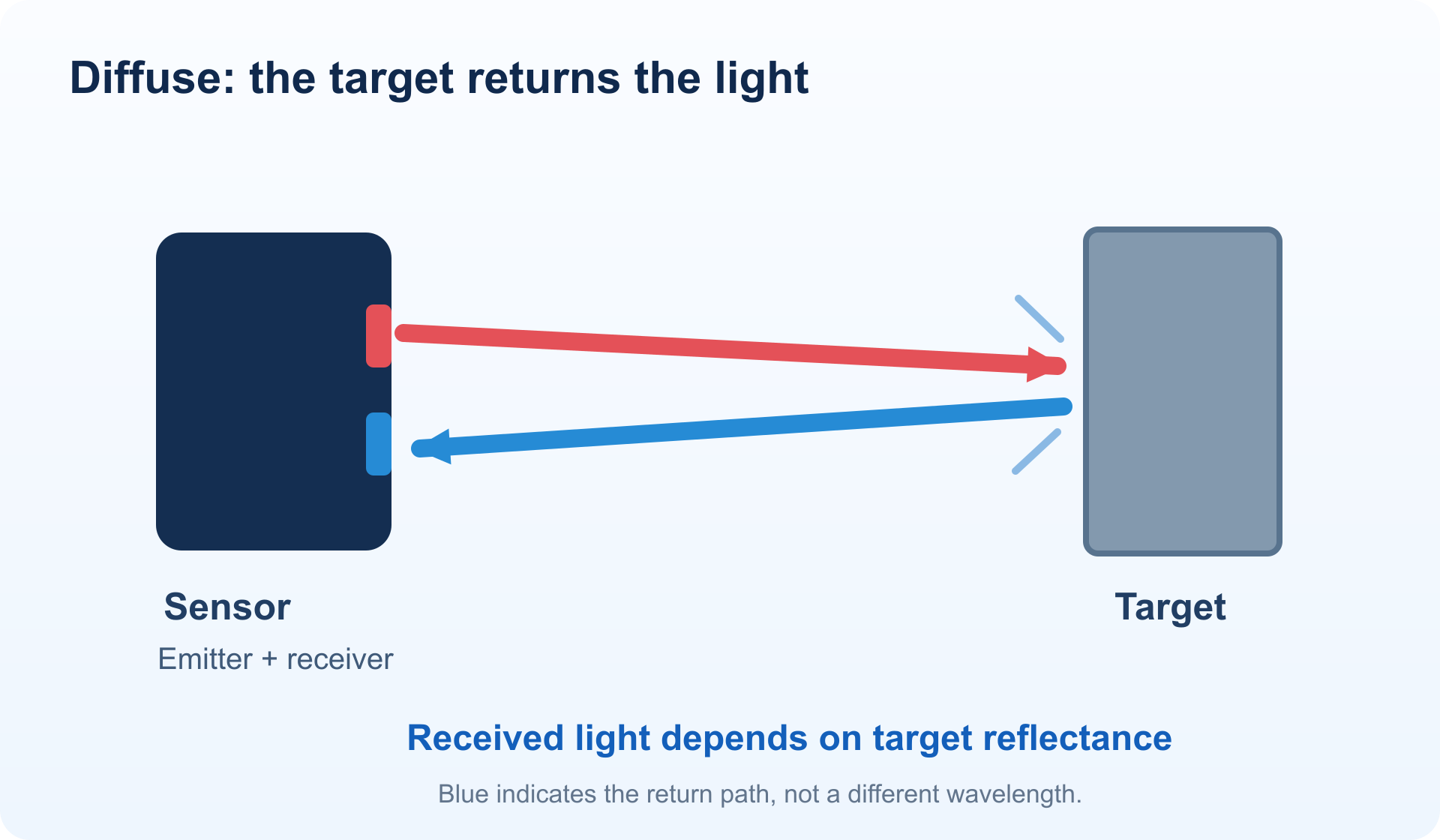
- Light path
- Sensor → target → sensor
- Typical trigger
- Light reflected from the target
- Installation check
- Actual target samples and background response
Where Are Photoelectric Sensors Used?
They are used for object presence, passage and position tasks where an optical path can be maintained. These are illustrative application types, not claims of tested customer installations.

Detect a package as it crosses a beam; verify gap, speed and controller timing.

Check product presence or position at a defined point in a packaging line.

Count passing containers with a suitable optical mode; transparent bottles need specific validation.

Detect a label edge or object feature when spot size, contrast and repeatability suit the task.
What Should You Check Before Selecting One?
A useful starting point is to describe the real target and the available light path. Compare candidate models under the same target, distance and mounting conditions; a catalog maximum is not a universal installation margin.
| Factor | What to check |
|---|---|
| Target and background | Size, shape, color, finish, transparency and nearest background surface. |
| Optical geometry | Distance, target path, available mounting sides, reflector space and alignment access. |
| Response and interface | Smallest target and gap, sensor response, PLC input timing, output type and switching mode. |
| Environment | Ambient light, dust, moisture, cleaning exposure, vibration and maintenance access. |
| Verification | Exact model’s stated target conditions and a trial with representative worst-case samples. |
What Are the Advantages and Limitations?
- Detects without touching the object.
- Can sense many target materials when an appropriate optical arrangement is chosen.
- Offers separate-beam, reflector-based and target-reflective options.
- Can support precise presence or passage checks when spot and timing suit the target.
- Dust, contamination or misalignment can reduce received light.
- Reflective, dark or transparent targets can require a different sensing mode or model.
- Ambient light and background objects may affect some installations.
- Ordinary process sensors are not personnel-protection safety devices.
What Common Setup Mistakes Cause Unstable Detection?
The emitter, receiver or reflector is not aligned through the full target travel. Check alignment with the actual bracket and movement.
A glossy target or nearby surface sends light into a receiver by another path. Reassess mode, angle and target geometry.
Dust, oil or condensation changes the received signal. Use the model’s maintenance guidance and inspect the optical surfaces.
A diffuse model is chosen for a difficult target/background pair without testing; compare alternative optical arrangements.
Frequently Asked Questions
What is the difference between through-beam, retroreflective and diffuse sensing?
Through-beam uses separate emitter and receiver units; retroreflective uses one sensor housing plus a reflector; diffuse uses light returned directly from the target. All three detect a change in received light, but their mounting and target sensitivities differ.
Can a photoelectric sensor detect transparent objects?
Some purpose-designed photoelectric models can. Clear objects may transmit much of the beam or create specular reflections, so use a model and setup specified for transparent targets and test the real material, shape and motion.
Does a dark target shorten sensing distance?
It can for diffuse sensing because a dark surface may return less light. The effect depends on the exact sensor, wavelength, target finish and geometry. Through-beam sensing relies on beam interruption instead of target reflectivity.
Why does the sensor work on the bench but miss objects on the line?
Check whether the real target crosses the full optical path, whether the background or dirt changes the signal, and whether the sensor pulse is long enough for the controller input. These checks distinguish sensing from downstream timing.
Is a photoelectric sensor suitable for machine safety?
An ordinary photoelectric process sensor should not be used as a personnel-protection safety device. A safety function requires appropriately rated equipment and a validated machine-level design.
Share the target material and size, sensing distance, background and available mounting positions. XSZ can help narrow the options before a model-specific trial.