
Industrial Sensor Manufacturer vs Distributor: What Should Buyers Know?
Choose a manufacturer when the purchase needs product changes or direct engineering decisions. A distributor may be more practical for an approved replacement held locally or an order covering several brands. Start with the buying need, then compare suppliers able to meet it.
Quick Comparison: Industrial Sensor Manufacturer vs Distributor
The useful distinction is what each route can do for your purchase. Use this overview to identify where to begin; the supplier's actual offer determines whether that route meets the requirement.
| Buying need | Manufacturer route | Distributor route |
|---|---|---|
| Main fit | OEM requirements and controlled repeat supply | Replacements and mixed-brand purchasing |
| Stock | May supply existing stock or arrange production | May offer products held locally or source them elsewhere |
| Customization | Reviews product changes within its engineering scope | May coordinate requests with the responsible manufacturer |
| Technical support | Product-specific clarification | Local application help and escalation, where offered |
| After-sales | Agreed seller/manufacturer procedure | Agreed distributor/manufacturer procedure |
Who Makes the Sensor, and Who Is Responsible for the Sale?
Separate the Manufacturer, Distributor, and Independent Reseller
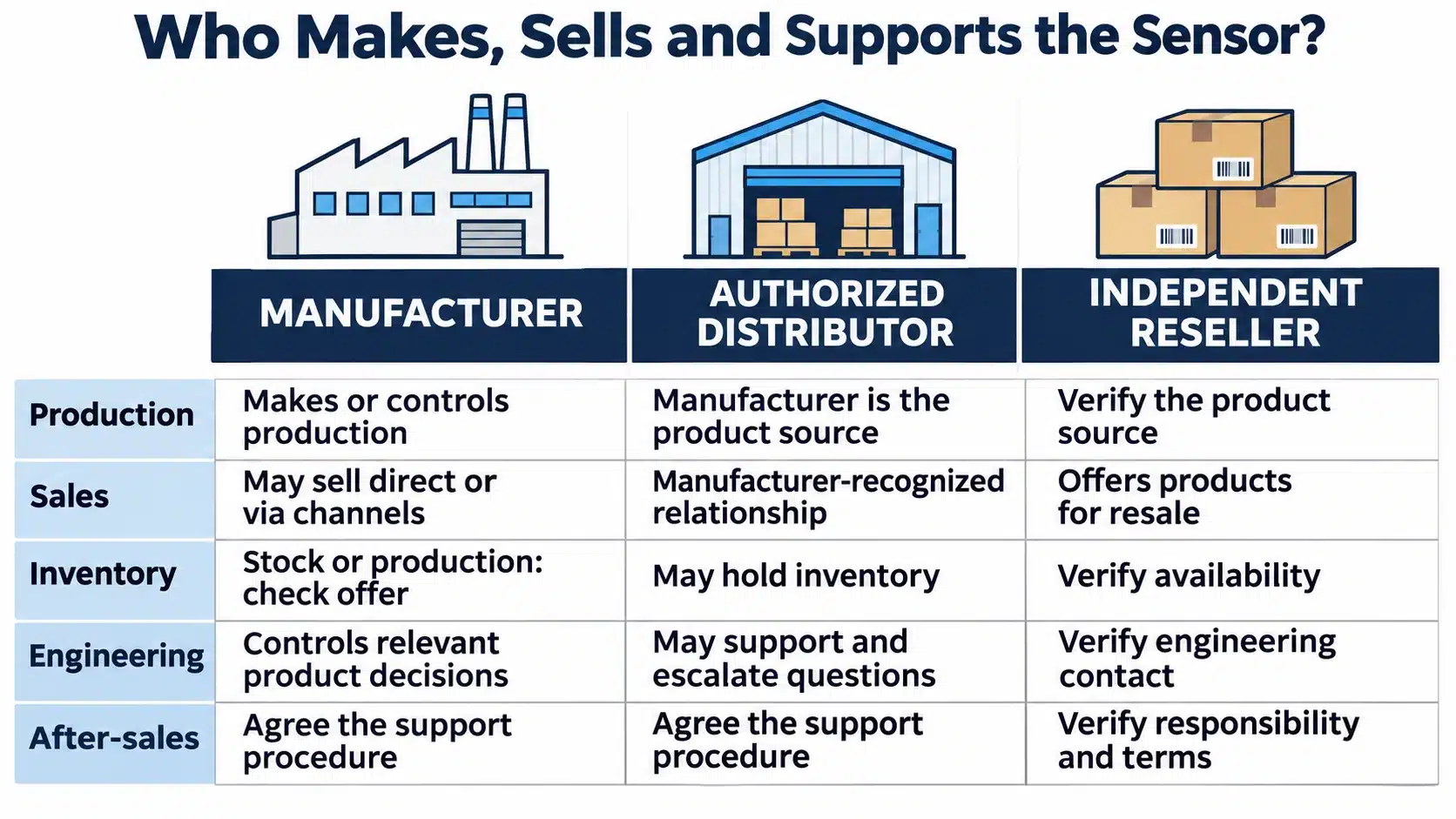
In this guide, a manufacturer makes the sensor, an authorized distributor has a relationship recognized by the relevant manufacturer, and an independent reseller offers products without that relationship necessarily being established. These are commercial roles, not a complete legal classification for every market. One company may perform more than one role.
Direct supply and distribution can coexist. CTS, for example, provides distributor inventory lookup alongside direct quotation and custom-product enquiries. A buyer can therefore have different purchasing routes into the same manufacturer's range. The important distinction is which organization supplies the order and which owns the product decisions.
Identify the Seller, Production Source, and Engineering Authority
Identify the company accepting the purchase order, the organization responsible for producing the sensor, and the team authorized to approve product changes. Those names establish the commercial and engineering path behind the offer.
If the quotation and product documents name different companies, ask how they relate. A distributor may legitimately be the seller while the manufacturer owns the drawing. Resolve that relationship early: otherwise, an application suggestion from a sales contact can be mistaken for approval of a modified product.
When Should You Buy Directly From a Manufacturer?
OEM Changes and Controlled Repeat Production
Manufacturer involvement is useful when the purchase requires an engineering decision. An OEM might need a shorter housing, a different cable exit or a connection that clears a machine cover. Describing the physical constraint gives the engineering team a problem to solve, rather than a request for an unspecified “custom version.”
For example, a clearance drawing may reveal that a standard connector option fits, avoiding a product change. If it does not, the proposed modification needs a defined configuration and an appropriate sample evaluation. That is the value of the engineering discussion: distinguishing a standard choice, a feasible change and a requirement that remains unresolved.
Repeat production adds a different need—keeping an accepted configuration identifiable across orders. Use the approved drawing or agreed configuration reference for reorders, and establish how proposed changes will reach your team. A forecast helps a supplier plan; it does not replace an agreed supply commitment.

Where Direct Purchasing May Not Meet the Buying Need
A manufacturer may need time for feasibility review, a production run or an overseas shipment. If your priority is restoring a stopped machine, waiting for a new production allocation may be less useful than sourcing an approved replacement already available nearby.
Small-order service and local assistance also vary. Establish early whether the supplier can accommodate the required quantity and support location. When buying directly from China, include the receiving destination and required arrival date in the enquiry so that production and delivery can be discussed against the actual need. The company's location alone does not determine its order terms.
When Is a Distributor the More Practical Route?
Urgent Replacements and Multi-Brand Orders
A distributor can help when it holds the required replacement within a useful delivery distance. For maintenance teams, the value is obtaining a usable part in time to restore the machine. A local office without access to the item does not provide that advantage.
A machine builder assembling an order across several brands faces another problem: coordinating multiple quotations and deliveries. A distributor able to supply those lines may simplify the purchase. Look at the build sequence as well as the combined order. If one critical item is delayed, obtaining it separately may serve the project better than holding everything for a single shipment.

Local Support and Access to Manufacturer Expertise
Local application support can help translate an observed machine problem into a useful technical question. A capable contact might help identify what the sensor is detecting, what the controller receives and which observation needs further investigation. The value is a clearer diagnosis, not simply having another person to call.
For a product-specific issue, agree on an escalation path. The distributor can collect the model, operating conditions, symptom and measurements, then take the question to the manufacturer's responsible team. Name the contact who will track the response and next action. This keeps local coordination useful without confusing it with authority to approve a design change.
Check Sensor Compatibility Before Comparing Offers
Match the Full Configuration to the Machine
When comparing a replacement, check the full part number, supply voltage, output type, switching logic, mounting dimensions and connector pinout. If any of these differ, ask the supplier to explain the difference before ordering. Include the model suffix because it may distinguish configurations that share the same basic housing.
Read the datasheet, dimensional drawing and wiring diagram together. The datasheet describes the relevant detection and electrical characteristics; the drawing establishes mechanical fit; the wiring information connects the proposed unit to the controller. A connector that mates mechanically does not establish that its pin assignment is suitable.
The sensing task also remains part of compatibility. Target material, size, movement, working gap and surrounding conditions can affect the choice. OMRON's proximity-sensor selection guidance addresses these factors alongside supply, connection and installation. Use the selected model's applicable data, and turn any unresolved machine condition into a specific sample-test requirement.

Resolve Differences Before Accepting a Replacement
Classify each material difference by its consequence: suitable as supplied, suitable after an accepted machine change or application test, or still unresolved. This is more useful than marking an alternative simply “equivalent.” A cross-reference finds a candidate; it does not make the compatibility decision.
For a proposed modification, retain the accepted configuration and the person authorized to approve it. An application recommendation and a revised product drawing answer different questions. Keep the acceptance decision with the supplied version so that later purchases do not revert to an earlier proposal.
Compare Supply, Purchasing Costs, and After-Sales Terms
Establish What Is Available and When It Can Be Delivered
An availability statement should distinguish stock held by the seller, stock at another location and a product awaiting production. Request the quantity available for your order, its location and the proposed dispatch date. The receiving date then depends on the agreed delivery arrangement.
For production supply, identify what starts the quoted lead time, such as acceptance of the specification or another agreed order milestone. For a stock allocation, establish how long the allocation remains available. These details turn an estimate into an offer your team can assess against the schedule.
Compare the Complete Offer on the Same Basis
Compare quotations for the accepted configuration and quantities. Read the unit price alongside freight, packaging, any development charges and the services included. Establish whether the minimum quantity applies to each configuration, a pack or the overall order; a mixed total may not satisfy a particular line's minimum.
Currency, payment arrangements and included or excluded destination costs should also be clear. Duties and taxes depend on the transaction and destination, so obtain the applicable information from the responsible logistics, customs or tax adviser where needed. An unspecified charge is an open comparison item, not an assumed zero.
A direct quotation may exclude work that a distributor has included, or it may fit a planned production requirement more closely. Choose using the costs and services relevant to the purchase. Missing drawings, uncertain availability or unanswered terms must be resolved before treating an offer as the cheaper suitable option; there is no useful blanket price ranking between the two channels.
Check Authorization, Traceability, and the Support Procedure
For a claimed authorization, use the manufacturer's official channel information for the brand and purchasing region. OMRON's industrial Asia Pacific directory is one example. Manufacturer-specific conditions can differ: Smiths Interconnect's distributor guidance includes regional authorization limits. Such examples do not establish a universal rule for all sensors. If a seller is absent from a directory, seek clarification rather than treating that absence alone as proof of counterfeit goods.
For the delivered product, establish what identification and source records can accompany the order. Depending on the agreement, that may include original product identification, lot information and relevant documentation. Ask for a representative record before making it a purchasing requirement. A traceability document connects a product to its stated source; it does not prove suitability for your machine.
Then agree on the practical route for a problem: who receives the report or returned unit, what information they need, who performs any manufacturer analysis and what the actual warranty or return terms cover. Keep a commercial replacement decision separate from the technical cause of failure. An unresolved installation problem can affect a replacement too.
For continuing supply, specify which substitutions need approval and how product-change or discontinuation information will reach the responsible contact. A proposed alternative should return to the compatibility decision above, rather than gaining acceptance because it appears on the same order line.
Four Buying Situations: Which Route Should You Try First?
These are hypothetical buying decisions, not XSZ customer cases, quotations or verified stock offers. Each row identifies the remaining decision after the general checks above have been understood.
| Need | Route to try first | What remains to resolve |
|---|---|---|
| An urgent replacement for an installed sensor | A source holding the approved configuration | Dispatch commitment; a different suffix returns the choice to compatibility review |
| A modified sensor for repeat OEM builds | The responsible manufacturer engineering team | Feasibility, accepted configuration and sample evaluation |
| A small order across several sensor brands | A distributor able to supply the required lines | Availability of the critical line and whether split delivery supports the build |
| Standard sensors for continuing bulk orders | Compare direct and distributor replenishment offers | Release schedule and agreed handling of changes or shortages |
What Should You Send With a Sensor Enquiry?
State whether the enquiry concerns an identical replacement, a suitable alternative or a new application. For an existing unit, attach its model information and available documents. For a new detection point, describe the target and installation problem. Add quantities by configuration, receiving destination and required arrival date; distinguish an immediate order from a forecast.
Include requested drawings, product-specific quality documents and any support needed for evaluation or ongoing supply. This gives the supplier a defined task and lets it identify missing information before quoting.
For an XSZ enquiry, send the target details, available installation space, supply voltage and output requirements, together with any existing model or drawing. XSZ's published application-review process can be used to assess a suitable standard model or a feasible project-specific configuration. Available changes depend on the sensor and application; the specification and any sample evaluation still need agreement.
Technical References
- OMRON Industrial Automation — Distributor Network: an official industrial Asia Pacific channel directory and scoped purchasing guidance.
- CTS — Distributor Stock Check: an example of distributor inventory lookup alongside direct quotation and custom-product enquiries.
- OMRON Industrial Automation — Overview of Proximity Sensors: target, electrical, environmental and installation factors relevant to sensor selection.
- Smiths Interconnect — Distributor Stock Check: an example of manufacturer-specific regional authorization guidance.
- XSZ Sensor — About Us: first-party information about application review and feasibility-dependent configurations.