

Sensor Terminology
Direct Current (DC)
Meaning, Working Principle and Industrial Uses
Direct current flows in one direction through a complete circuit. This guide explains the current path, how DC differs from AC, and what a DC supply rating does—and does not—tell you about an industrial sensor.
Learn how DC worksWhat Is Direct Current (DC)?
Direct current is electric current that flows in one direction through a circuit. A DC supply ordinarily maintains the same polarity at its output terminals. Unlike alternating current (AC), DC does not periodically reverse direction.
DC does not have to be perfectly constant. Its voltage or current magnitude can change with load, battery discharge or power-supply ripple while the overall current direction remains the same.

How Does a DC Circuit Work?
A source such as a battery or DC power supply establishes a voltage difference across its terminals. When a conducting path connects the source, the load and the return terminal, current can flow through the complete loop. The load uses the electrical energy; opening the path stops the current.
The diagram follows conventional current direction, from the positive terminal through the load and back to the return terminal. This direction convention is opposite to electron movement in a metal wire.
Voltage describes the potential difference; current describes the flow. A “24 V DC” label states a supply voltage, not a fixed current through every load.
Swipe to see the full circuit diagram.
Key Characteristics of DC
One current direction
The direction of current through a given load does not periodically reverse.
Defined supply polarity
DC-powered equipment identifies positive and return terminals; wiring must follow its diagram.
Magnitude may vary
Regulated outputs can have ripple, and current changes as the load changes.
Common in control circuits
Many sensors, controllers and electronic modules are designed for DC supplies.
DC vs. AC: What Is the Difference?
| Item | Direct Current (DC) | Alternating Current (AC) |
|---|---|---|
| Current direction | Flows in one direction. | Reverses direction periodically. |
| Polarity | Ordinarily maintains polarity at the supply terminals. | Polarity alternates over each cycle. |
| Magnitude and waveform | May be steady or vary without reversing direction. | Instantaneous current changes sign as direction reverses; the waveform need not be a perfect sine wave. |
| Voltage level | No single voltage defines DC. Select the supply from the device rating. | No single voltage defines AC. Ratings depend on the equipment and location. |
| Industrial examples | Sensor and controller supply circuits, electronics. | Facility distribution and AC-powered equipment. |
What Does DC Mean for an Industrial Sensor?
Many three-wire proximity and photoelectric sensors use a DC supply for their internal electronics. In a typical three-wire arrangement, two connections power the sensor while a separate connection carries its switching output to a controller. This describes their roles, not a universal color or pin assignment.
A “24 V DC” control supply does not identify the sensor's output behavior. Its rated supply range and ripple limit must be checked separately from its NPN or PNP output, normally open or normally closed mode, output load rating and the PLC input requirements.

How to read the relevant sensor ratings
These fields answer different questions. One matching number does not establish that the complete sensor-to-controller connection is compatible.
| Datasheet field | What it tells you | Next check |
|---|---|---|
| Supply voltage and ripple | Allowed voltage conditions for powering the device. | Compare with the supply delivered at the sensor terminals. |
| Current consumption | Power drawn by the sensor's own electronics. | Account for it in the DC power-supply budget. |
| Output type and mode | How the output switches (such as NPN or PNP) and when it is active (such as NO or NC). | Match the output circuit to the controller input and the required detection logic. |
| Output load rating | What the switched output is permitted to drive under stated conditions. | Check the actual connected load and the model's wiring diagram. |
Illustrative example: A panel may provide 24 V DC, but that alone does not make every “DC sensor” suitable. The voltage at the sensor must fall within its stated range, and its output must suit the PLC input. The supply pair and the switching signal serve different functions.
Typical Industrial Applications

Manufacturing automation
DC-powered sensors help detect parts and machine positions on production lines.

Packaging machinery
Photoelectric and proximity sensors can report product presence and position.
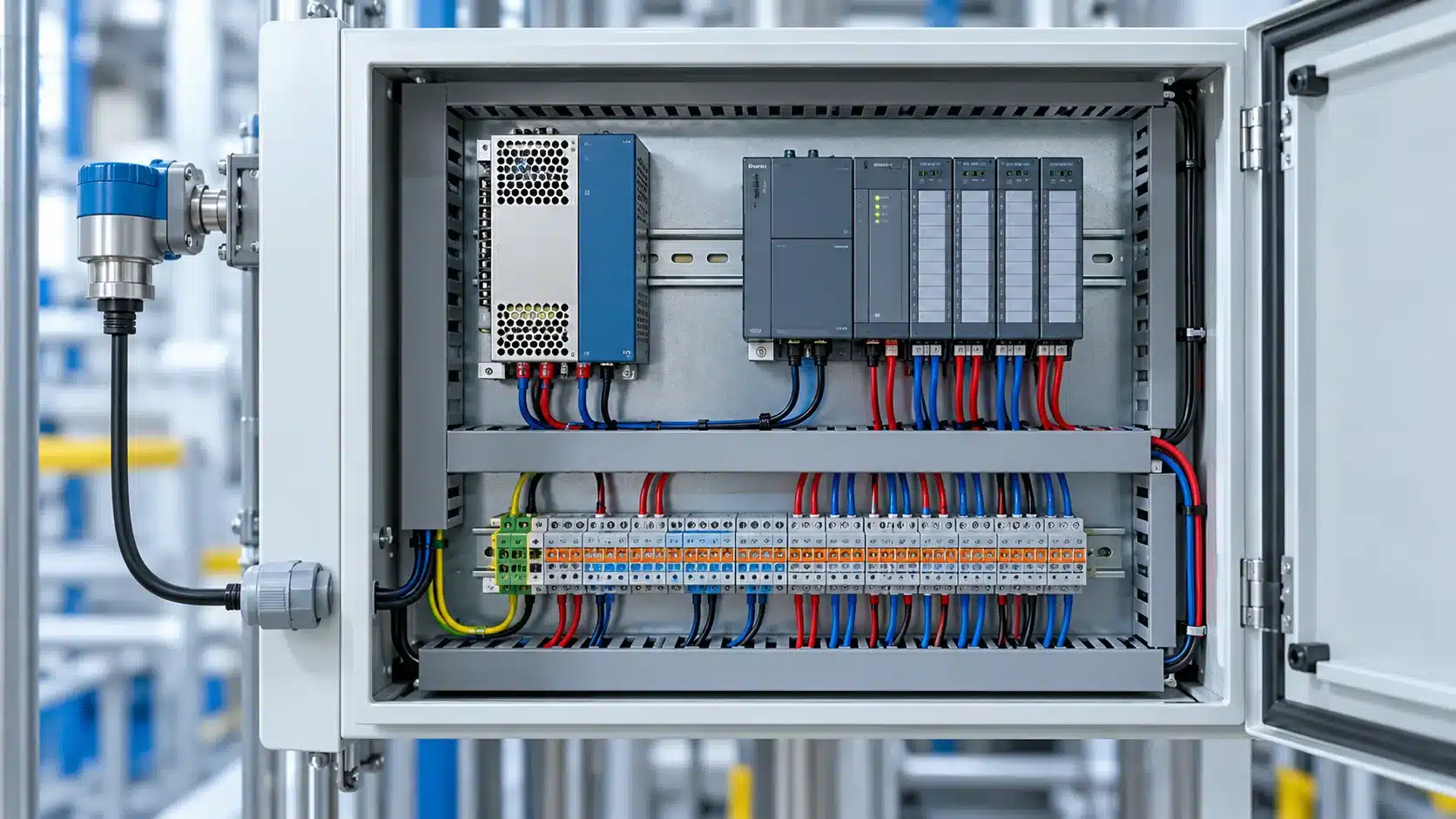
Control panels
DC supply circuits power controllers, input modules and compatible field devices.
Frequently Asked Questions
What is the difference between DC voltage and DC current?
Voltage is the electrical potential difference between two points, measured in volts. Current is the rate of charge flow through a complete path, measured in amperes. A supply marked 24 V DC does not force the same current through every connected load.
Where does the DC supply in a control panel come from?
It is commonly provided by a DC power supply that converts an AC input, although batteries and other DC sources are also possible. The required supply depends on the equipment design.
Does a DC supply determine whether a sensor is NPN or PNP?
No. DC describes the supply/current type; NPN and PNP describe different switching-output arrangements. Check the exact sensor output circuit and the PLC input specification before wiring them together.
Can every industrial sensor be powered by DC?
No. Sensors have different power requirements, including AC-powered and universal-input designs. Use only a supply within the stated range for the exact model.