Emit light toward the target

The sensor projects light into the monitored area. Its optical geometry and spot size define where a target can be assessed.

Sensor Terminology
Meaning, Working Principle and Applications
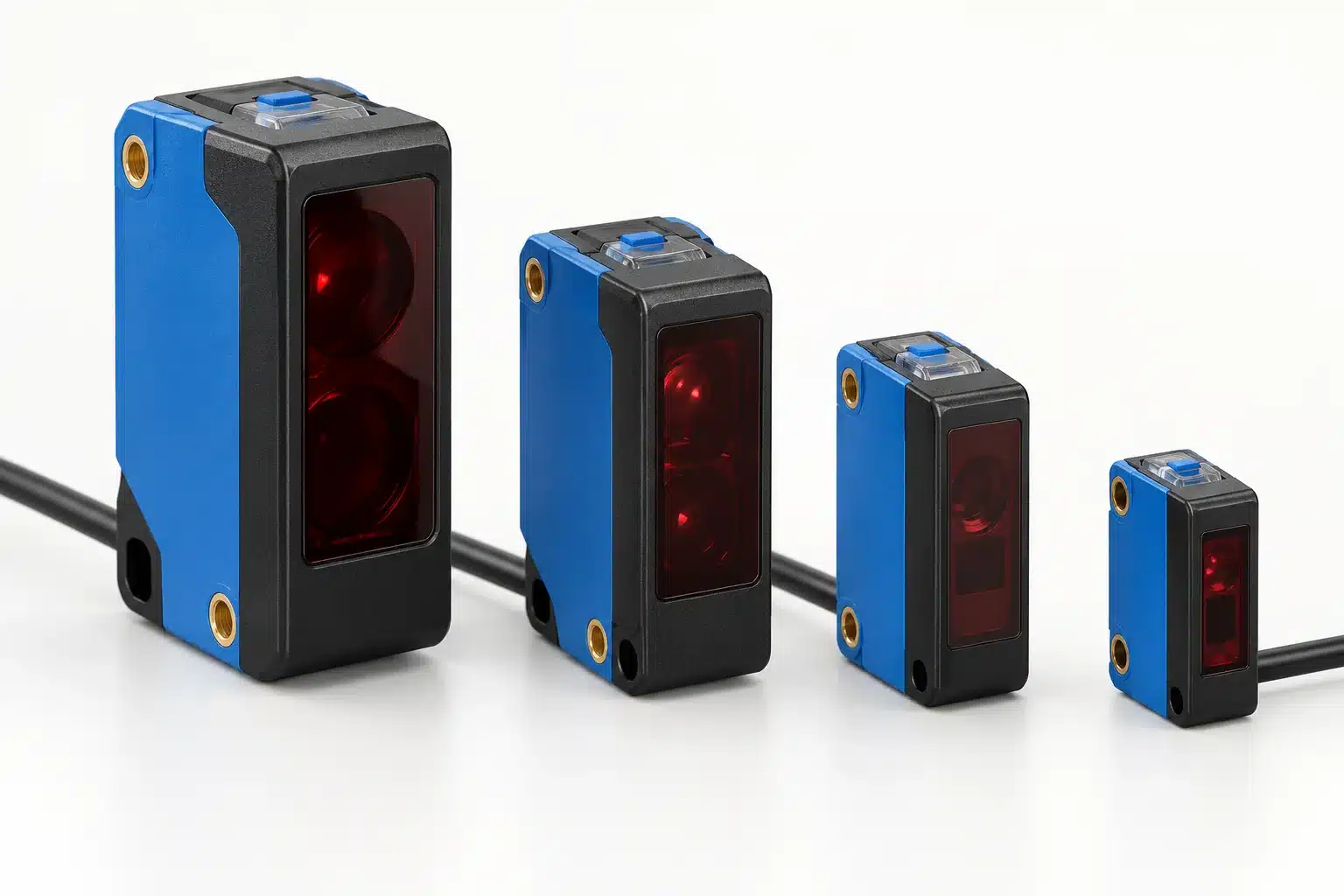
Background suppression (BGS) is a photoelectric sensing method that helps detect a target within a selected distance while reducing responses from objects farther away.

A background-suppression photoelectric sensor emits light toward the scene and evaluates the light returned from a target. Unlike a basic diffuse-reflective sensor that mainly responds to received-light intensity, a BGS design uses distance-related optical information to distinguish a nearer target from a farther background.
The sensor is set to a cutoff or sensing range. A suitable target in the operating area can be detected, while a surface beyond the selected boundary is suppressed. “Suppressed” does not mean every background is invisible under every condition: the exact model, target and installation determine the result.

Many distance-settable BGS sensors use optical triangulation: the position of the returned light on the receiver changes with target distance. Other product designs can implement distance discrimination differently, so check the selected model.
The sensor projects light into the monitored area. Its optical geometry and spot size define where a target can be assessed.

Light reflected by the target reaches the receiver. In a triangulation design, the return position provides distance-related information, not merely brightness.

The sensor applies its configured switching condition: a suitable target within range is recognized; a farther background is suppressed.
Separates a nearer target from a more distant surface when the chosen model has a suitable cutoff and operating margin.
Distance-based evaluation can reduce, but not eliminate, changes caused by target color or reflectivity compared with basic energetic diffuse sensing.
The emitter and receiver share a housing, so an opposite-side reflector or receiver is not required.
Can support repeatable presence checks near conveyors and machine surfaces after the real motion and background are tested.
These are application examples, not claims about a particular XSZ model or tested customer installation.

Detect a passing carton while the belt or frame behind it remains outside the selected sensing distance.

Check for a package at a defined position without treating a farther machine guard as the intended target.

Check suitable opaque bottles or cartons against a distant background. Transparent or highly reflective targets need model-specific trials.
Both methods can use reflected light from the target, but they decide what to detect in different ways. The table describes general principles; individual product designs vary.
| Feature | Background-suppression sensor | Standard energetic diffuse sensor |
|---|---|---|
| Main decision basis | Target return evaluated with distance-related information or a set sensing boundary | Primarily the amount of light returned from the target |
| Farther background | Designed to suppress a background beyond the selected cutoff | A sufficiently reflective background may also be detected |
| Target color or finish | Often less affected, but dark, glossy, angled or irregular targets still need testing | Changes in reflectance can strongly change operating distance |
| Setup question | Where should the cutoff sit relative to the nearest target and background? | Is there enough return-light contrast between the target and its surroundings? |
| Good starting use | Foreground presence with a close but separable background | General detection when the target/background contrast is sufficient |
Set the boundary with margin between the farthest valid target surface and nearest background. Check the model’s specified minimum and maximum sensing distances.
Use the smallest, darkest, glossiest or most angled real sample. Verify that it returns enough usable light throughout its travel path.
Check spot placement, vibration, ambient light, dust, washdown exposure, target speed and controller input timing under actual operating conditions.
A basic energetic diffuse sensor mainly reacts to the strength of light reflected from an object. A BGS sensor uses distance-related information or a defined sensing boundary to favor a nearer target and suppress a farther background. Exact implementations vary by model.
No. A target must still lie within the model’s operating range and provide a usable optical return. Target size, material, angle, surface finish and motion can affect reliable switching.
Measure the nearest background and the farthest surface of every valid target, then choose a cutoff with practical separation and installation margin. Follow the selected model’s teach-in or adjustment procedure and test both target-present and target-absent states.
Some models are designed for difficult surfaces, but no BGS label guarantees all such targets. Very dark targets may provide little return; glossy or angled surfaces can redirect light; transparent materials may need purpose-designed optics. Test representative worst-case samples.
Only if the exact sensor’s environmental rating and optical performance suit the location. Check ambient light, temperature, water or dust exposure, mounting stability and the actual target/background geometry.
Share target and background distances, material, size, speed and controller input. XSZ can help narrow the options for a model-specific trial.