
Sensor Terminology
Diffuse-Reflective Sensor
Meaning, Working Principle and Applications
A diffuse-reflective photoelectric sensor has an emitter and receiver in one housing. It detects an object when enough of the emitted light reflects from that object back to the receiver—without a separate reflector.
Learn how it works →
What Is a Diffuse-Reflective Sensor?
It is a photoelectric sensor that sends light toward a target and monitors the light returned by the target itself. The emitter and receiver sit in the same housing, so there is no separate reflector or receiver to install on the opposite side. Detection depends on receiving enough reflected light at the installed distance.

How Diffuse-Reflective Sensors Work
Sensor emits light
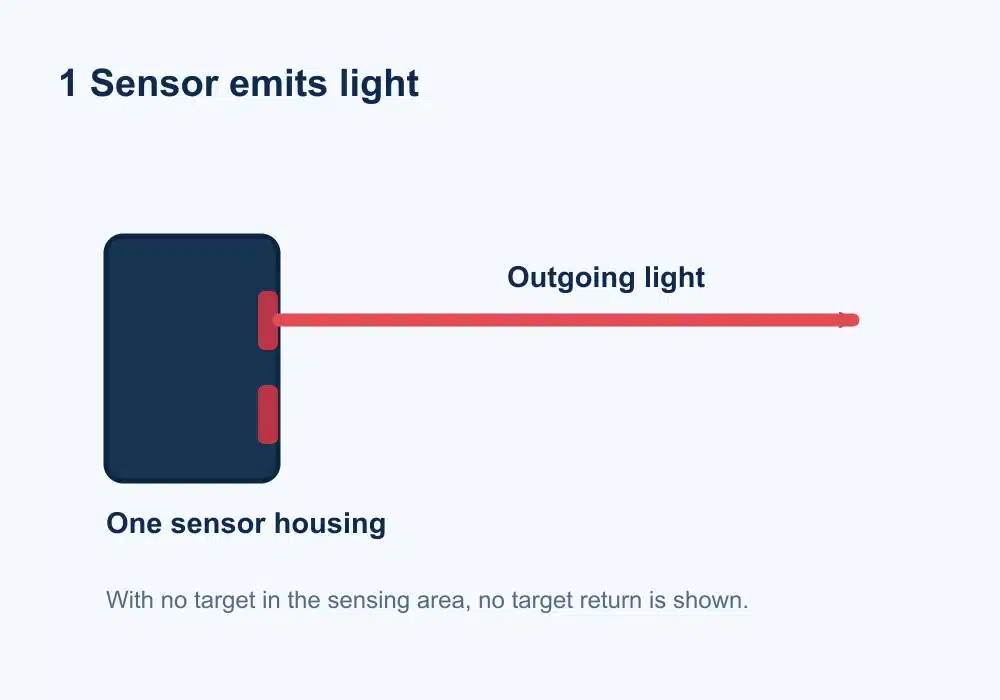
The sensor projects light into the sensing area. Source color, beam shape and spot size depend on the model.
Object reflects some light
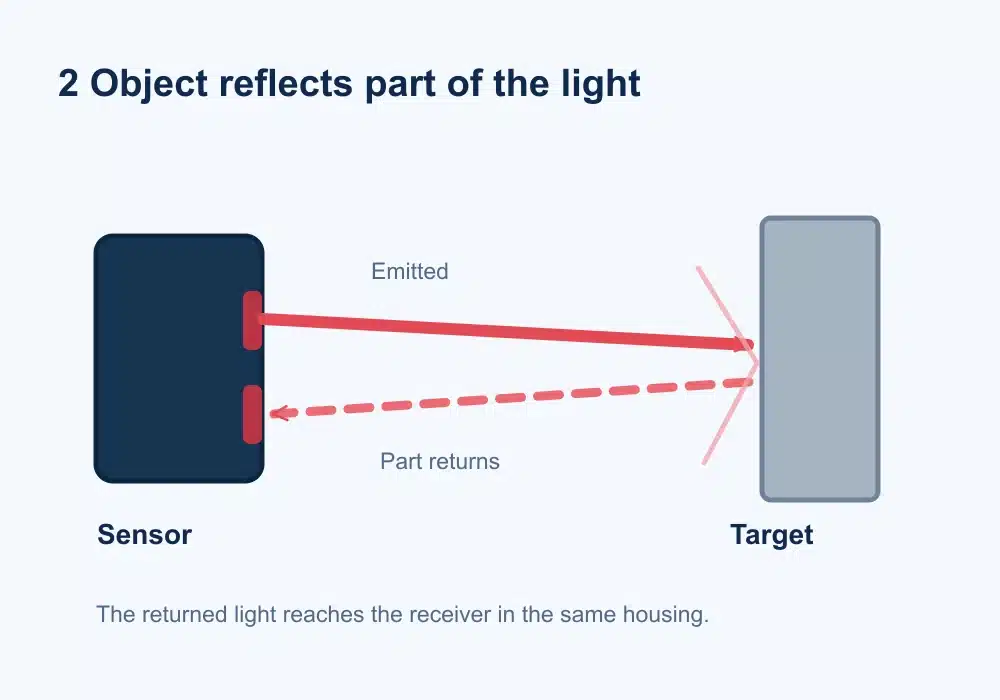
A target in the beam returns part of that light toward the sensor. Target surface and angle affect how much returns.
Receiver evaluates the return
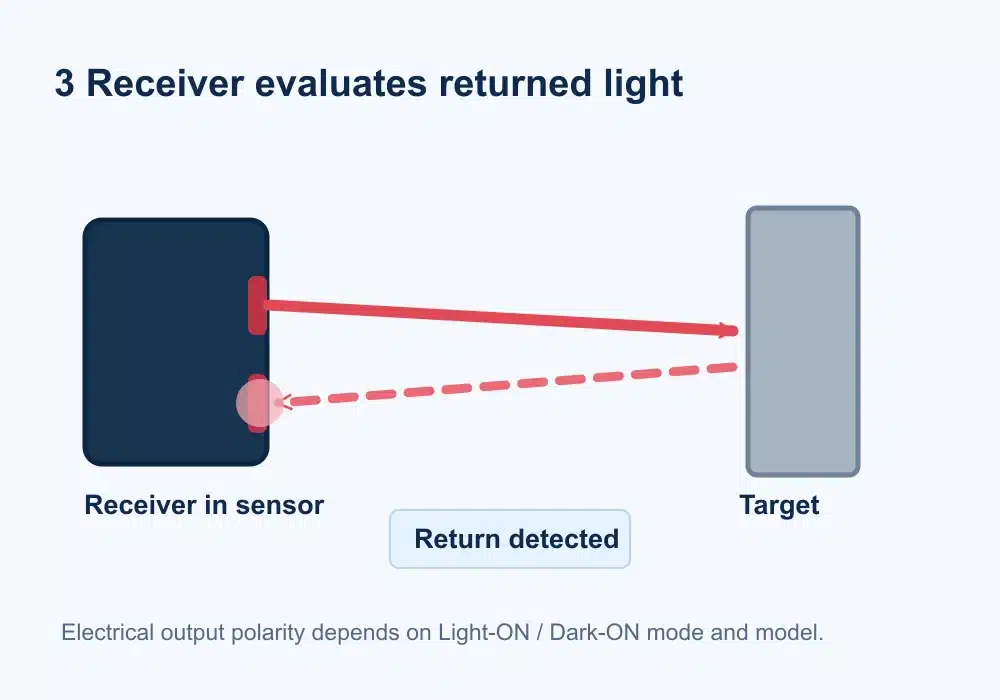
When received light crosses the set threshold, the sensor changes its switching state. Electrical ON/OFF behavior depends on its mode.
Important: Do not assume that every dark, shiny or transparent target will be detected at the rated distance. Confirm the actual target and background with the chosen model.
Main Advantages
Single-sided installation
Only the sensor needs a mounting position; there is no opposite-side unit to align.
No reflector required
The object itself returns the light used for detection.
Compact arrangement
Emitter and receiver share one housing, which can simplify local mounting.
Useful for presence checks
Works well when the target produces a repeatable return and the background is controlled.
Typical Applications
Diffuse-reflective sensing is useful when a separate reflector or receiver cannot be mounted opposite the target. Check the real surface and background before final selection.

Conveyor Object Detection
Detect suitably reflective boxes or containers passing a defined point on a conveyor.

Packaging Machinery
Confirm product presence before a filling, labeling or handling step when the target return is stable.

Product Presence Detection
Check for a part at an assembly or inspection station without an opposite-side mounting point.
Diffuse-Reflective vs. Other Photoelectric Sensors
| Item | Diffuse-reflective | Retro-reflective | Through-beam |
|---|---|---|---|
| Optical arrangement | Emitter and receiver share a housing; the target returns the light. | Emitter and receiver share a housing; a separate reflector returns the light. | Separate emitter and receiver face each other. |
| Detection event | Target returns enough light to reach the switching threshold. | Target sufficiently interrupts the path to and from the reflector. | Target sufficiently interrupts the direct beam. |
| Hardware to mount | One sensing unit. | Sensor and reflector. | Emitter and receiver on opposite sides. |
| Key selection issue | Target reflectance, distance and background can change the received signal. | Reflector alignment and target behavior must be checked. | Pair alignment, beam coverage and mounting on both sides must be checked. |
Typical sensing range and object suitability vary by model and installation. Compare actual datasheets and sample-test the target rather than using one range figure for every design.
Selection Tips
Color, gloss, texture, transparency and angle can all change the amount of light returned.
Use the selected model's rated conditions, then test at the installed gap with production samples.
A nearby background may return light too. If separation is difficult, evaluate a background-suppression model.
Frequently Asked Questions
What is the difference between diffuse-reflective and retro-reflective sensors?
Both commonly place emitter and receiver in one housing. A diffuse-reflective sensor relies on light returned by the target itself; a retro-reflective sensor uses a separate reflector and usually detects a target when it interrupts that return path.
Can diffuse-reflective sensors detect dark or shiny objects?
They can in some applications, but there is no universal guarantee. A dark surface may return too little light, while a glossy surface can redirect light away from the receiver. Test the actual target, orientation and background with the exact sensor model.
What affects the sensing distance?
The chosen sensor's optics and settings matter, as do target size, color, finish, angle and surrounding conditions. Published distances are based on specified reference targets and test conditions; verify the installed distance with representative parts.
When should I choose a diffuse-reflective sensor?
It is a practical option when you can mount a sensor on one side only and the target reliably returns enough light against its background. Consider retro-reflective, through-beam or background-suppression sensing if target variation or nearby backgrounds make ordinary diffuse detection unstable.
Is the sensor output always ON when an object is detected?
No. Light-ON/Dark-ON selection and the electrical output type determine what the controller sees. Verify the selected model's switching mode and wiring diagram.