

How Does a Sinking Input Work?
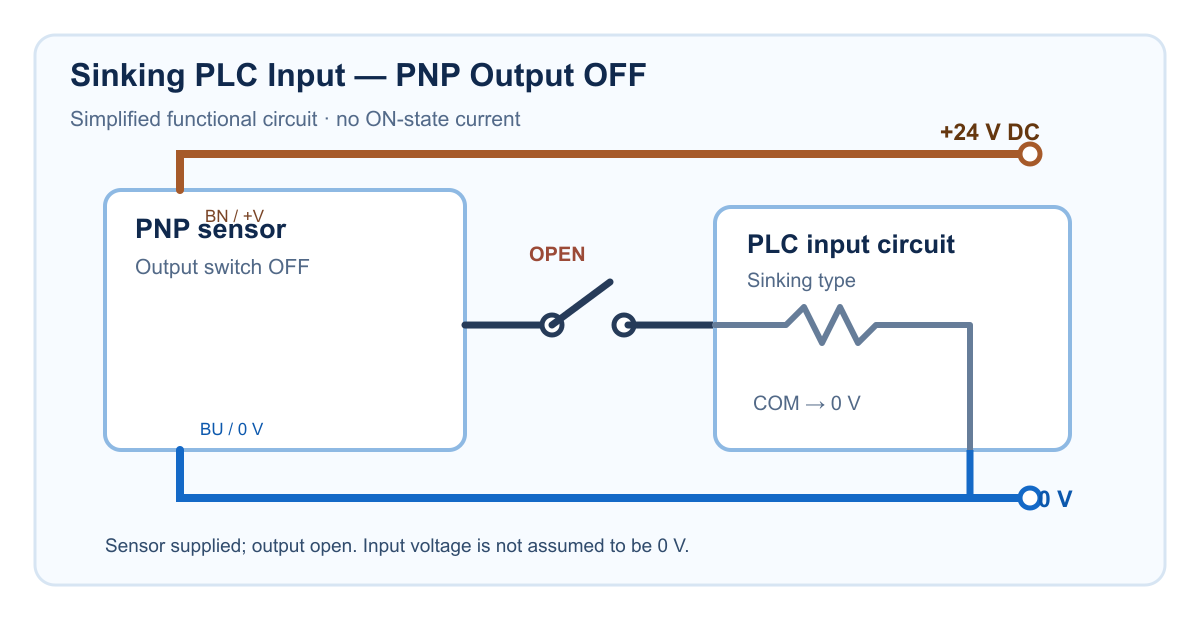
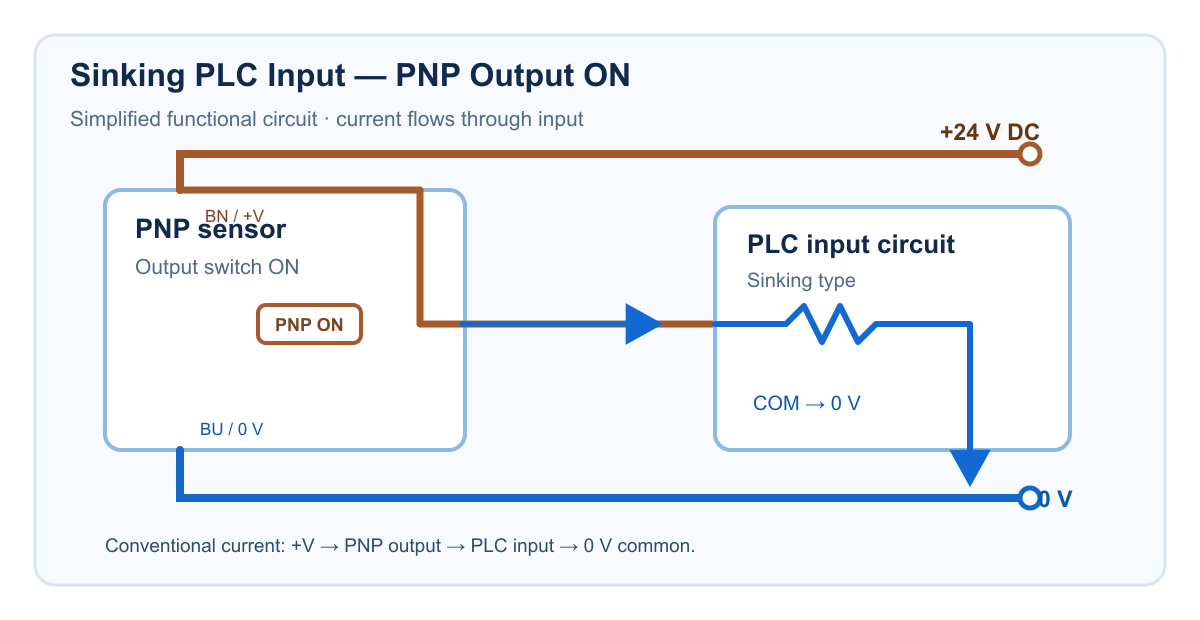
In the illustrated DC case, the PLC input circuit sits between the input terminal and a common terminal connected to 0 V. With the PNP output OFF, the sensor does not provide an ON-state current path to that input. When the sensor output turns ON, current flows from +V through the sensor output, into the PLC input circuit and back to 0 V. The module then recognizes the input if its specified ON threshold is met.
 Open full-size diagram ↗
Conceptual state only; check OFF-state leakage and the module's OFF threshold.
 Open full-size diagram ↗
The actual ON voltage and current depend on the specified sensor and input module.
Sinking vs Sourcing Input
The names describe what the input module provides in the field circuit. A sinking input offers a return path to 0 V and is paired with a sourcing (PNP) output. A sourcing input provides a path from +V and is paired with a sinking (NPN) output. Some modules support either configuration when their common is wired appropriately; do not infer that from the word “DC” alone.
| Item | Sinking PLC Input | Sourcing PLC Input |
|---|---|---|
| Complementary sensor output | PNP, sourcing | NPN, sinking |
| Input current path | From field output through input to 0 V common | From +V common through input to field output and 0 V |
| Typical input common | Connected to supply return (0 V) | Connected to positive supply (+V) |
| ON-state field signal | PNP output supplies positive voltage/current to input | NPN output pulls input toward 0 V |
- Read the input module's exact sink/source wiring diagram.
- Confirm the common-terminal connection for the input group.
- Match the sensor output type and the module's DC voltage/current thresholds.
- Check whether the output function is NO or NC separately.
How Do You Wire a Sensor to a Sinking Input?
The example below uses a three-wire PNP sensor and a DC PLC input specified to accept a sourcing field signal. The sensor positive supply connects to +V; its 0 V lead and the PLC input common return to the same 0 V reference; the PNP output goes to the selected PLC input terminal. Use the actual pinout and input-group manual before installation.


Where Are Sinking Inputs Used?
Sinking DC inputs can accept signals from compatible PNP sensors in many control tasks. The application determines the sensor technology; the input type only determines part of the electrical interface.

A compatible sensor reports the presence or position of a target to the controller.

A sensor output provides a discrete event for counting parts on a line.

A suitable level sensor sends a switching signal to the PLC input.

A compatible field device reports a machine condition to a control module.
Why Is the Input Not Switching?
If a PNP sensor appears to change state but the PLC does not, first compare the actual sensor output type and input-module wiring diagram. Then check the input-group common, supply reference, ON/OFF voltage thresholds, output current capacity and any input filter or software inversion. A controller indicator may not describe the electrical state at the terminal; the exact module manual controls the interpretation.
Frequently Asked Questions
What does “sinking input” mean in a PLC?
It means the DC input circuit provides a current path from its input terminal toward the supply return. A compatible field device supplies current into that input when ON.
Which sensor output works with a sinking input?
A PNP sourcing output is the conventional match. Confirm the actual input module's wiring diagram, common and electrical ratings before connecting a specific sensor.
Does a sinking input work with an NPN sensor?
Not in the conventional direct three-wire pairing: an NPN sensor sinks current and normally pairs with a sourcing PLC input. A configurable sink/source input module may support either arrangement when its common is wired as specified.
Is a sinking input active low?
Typically no. In the conventional PNP-to-sinking-input circuit, the ON sensor sources a positive signal into the input. Controller program logic or labels may invert the displayed state, so check the module's electrical specification and configuration.
How can I identify my module's input type?
Use the exact input module model and wiring diagram. Check which supply polarity connects to the group's common terminal and whether the module expects a sourcing PNP or sinking NPN field output.